| Lens Zone | What It Is Tuned For | The Task |
|---|---|---|
| Bottom third | Full reading strength (the power you choose) | Books, menus, and fine print |
| Middle third | Reduced strength | A screen at arm's length |
| Top third | About half your reading strength | Face-to-face conversation across the desk |
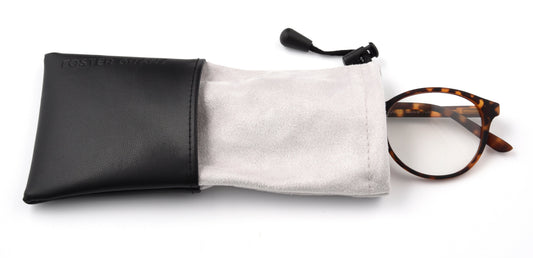
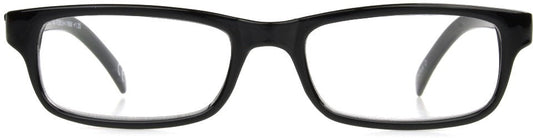
The Conan is a good first look: a versatile rectangular frame in durable plastic, offered in Tortoise, Grey, and Black. The scratch- and impact-resistant lenses come with a protective case and cloth in the box. The matte James adds a metal inlay temple detail if you want something a touch dressier. Either one stays put while you move between a document, a laptop, and a conversation, which is the closest thing there is to genuinely wearing readers all the time.
Want magnification only where you read? The Everett brings Pop of Power® Bifocal-Style* lenses to a playfully round, soft, matte rubberized tortoise frame with spring hinges. Pop of Power® puts a magnified reader segment at the bottom of the lens and leaves the rest unmagnified for middle and far distances. Bifocal style readers have unmagnified lenses which also contain inserts with the magnification of your choice in the lower portion of the lenses. So you glance down to read, and look up through the unmagnified part of the lens. Compare the ranges in the Multi Focus™ reading glasses collection and the bifocal reading glasses collection.
Making a Pair Comfortable From Morning to Night
Hours of wear put the frame to work as much as the lens. A pair you keep on from breakfast to the evening news has to sit lightly on your nose and stay put when you look down at a page. Spring hinges help here. They give the temples additional movement for improved fit and durability, which counts when you push your readers up onto your head and back down twenty times a day. The round Everett above is one pair that has them.
Test the fit the simple way: wear a new pair for an hour around the house. If it leaves red marks on your nose, slides down while you read, or presses behind your ears, it won't feel better by hour eight. Strength is the other all-day factor, so choose the lowest power that makes ordinary print clear.
You may also wonder whether wearing them all day will leave you needing them more. It won't. [1] Near focus changes on its own schedule through presbyopia, the normal stiffening of the eye's lens after about age 40, and an eye exam is the way to confirm the strength you need as it shifts. [2]
Keep Them On, Take Them Off, or See a Pro
Most days sort themselves out with one simple rule. If your day stays close, with reading, crafting, or paperwork, keep a single-vision pair on as long as you like. If it jumps between a page, a screen, and the room, a Multi Focus™ pair means no more taking readers on and off between page, screen, and room. For driving or anything genuinely far away, take your readers off, Multi Focus™ included, since every zone of a reading lens carries some magnification.
Heading outside to read? SunReaders® like the aviator Accuracy tuck the reading segment into the bottom of a tinted lens, which carries 100% UVA-UVB protection, so you can read on the patio and still glance up at the yard. Browse those in the sun readers collection.
One thing a pair of readers can't do is replace an eye exam. If your vision changes in a way that worries you, or your readers stop helping the way they used to, see an eye-care professional before simply reaching for a stronger pair. An exam is also the way to confirm the exact strength you need. [2] Sort that out first, then wear your readers as much as the day genuinely calls for. Start in the reading glasses hub and pick the pair you will actually want to keep on.
Sources
[1] American Academy of Ophthalmology, "Do Reading Glasses Damage Eyes?" — over-the-counter reading glasses are a magnifying aid and do not damage or weaken a healthy eye, or make it dependent on them. (aao.org)
[2] American Academy of Ophthalmology, "What Is Presbyopia?" — after about age 40 the eye's lens becomes more rigid, so near focus gradually becomes harder; it is a normal part of aging that cannot be stopped or reversed, and the power of reading glasses you need should be determined by an eye exam. (aao.org)