So, Do Readers Help Hyperopia?
Readers add plus power in the same direction a prescription uses to pull close-up detail into focus. For presbyopia, the age-related near shift, a ready-made pair is exactly the right tool. [2] Someone with mild, uncorrected farsightedness may find that a low strength makes reading more comfortable too, because the plus boost works with the eye's close-up demand rather than against it.
What a reader cannot do is stand in for a real correction. One strength runs across the whole lens. The left and right lenses are identical. The optical centers are set to an average face, not measured to yours. A reader does nothing for distance. It carries no correction for astigmatism, the uneven curvature that blurs near and far alike. And it knows nothing about how your two eyes differ. [3] True farsightedness is diagnosed and corrected with lenses an eye doctor fits to your eyes. [1] So readers earn their keep as a flexible near-vision aid. They are not a diagnosis, and they do not replace the exam that names what is really going on.
When Readers Are the Right Call, and When to Book an Exam
Say your trouble is close-up only. Your distance vision is still crisp, both eyes seem about even, and you are in your 40s or beyond. Then ready-made readers are a sensible, low-commitment place to start. Pick the lowest strength that makes ordinary print effortless at your natural reading distance. Step up a quarter diopter only if the words still look soft, since too much power forces you to hold the page uncomfortably close.
Some signals point past the readers rack, though. Book a comprehensive eye exam if print blurs at every distance, not just up close. Do the same if one eye is clearly sharper than the other, if reading brings on headaches or double vision, or if you simply have not had your eyes checked in a few years. More than 150 million Americans have a refractive error, and plenty do not realize they could be seeing better. [3] Children are their own case. A child who seems farsighted needs a professional exam, not a pair off the shelf, because children with severe farsightedness may be at higher risk for crossed eyes. [1] None of this takes readers off the table. It means the exam finds the right answer first. Often that answer still includes a pair of readers for the hours you spend up close.
Matching a Pair to Your Day
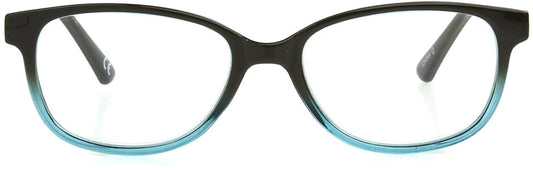
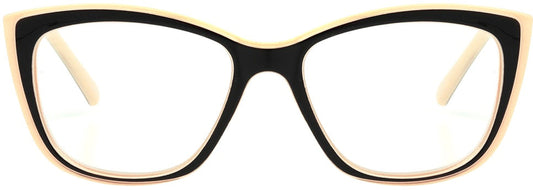
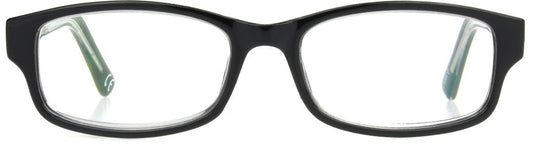
If ready-made readers suit your eyes, the choice comes down to how you read, and regular eye exams keep that choice on track. A novel in one chair is happy with single-vision readers. A day that bounces between a document, a monitor, and a colleague is what Multi Focus™ lenses like the Sawyer were built for, so you stop swapping pairs. If you mostly want to glance up between paragraphs, a Pop of Power® Bifocal-Style* frame like the Everett keeps the top of the lens clear for the room. Start by browsing strengths and fits in our reading glasses hub. Compare the three-zone options in the Multi Focus™ collection, or see the glance-up styles in our bifocal reading glasses. Men's and women's frames each have their own shelf, from the men's readers to the women's readers. Whatever lands on your nose, let the number be the one your eyes settle on at an arm's length of small print, not the one that looked boldest on the display.
Sources
[1] National Eye Institute — Farsightedness (Hyperopia): a refractive error in which the eyeball is too short or the cornea or lens is misshaped, focusing light behind the retina so nearby objects blur; most people are born with it, mild cases can go unnoticed, it is corrected with prescription lenses, and children with severe farsightedness may be at higher risk for crossed eyes.
[2] National Eye Institute — Presbyopia: a normal, age-related refractive change beginning after about 45 as the eye's lens stiffens, making near objects blurry; it is distinct from farsightedness, and some people manage it with over-the-counter reading glasses.
[3] National Eye Institute — Refractive Errors: the four common types are nearsightedness, farsightedness, astigmatism, and presbyopia; more than 150 million Americans have a refractive error, and regular eye exams are how an eye doctor confirms the right correction.