Types of Glasses Frames Explained: Shapes, Materials, and Parts
Shape, material, and rim build: those three decisions are what actually separate one pair of glasses from another. Shape flatters (or doesn't) your face. Material decides how the frame holds up over years of wear. Rim build — full rim, semi-rimless, or rimless — decides how much of the frame you actually see. Foster Grant works across six shapes you already know by sight, three materials worth telling apart, and all three rim builds. Learn those three calls, plus the half a dozen labeled parts every frame is built from, and a spec sheet stops being a guessing game.
The Different Kinds of Frames for Glasses, by Shape
Round frames are the oldest silhouette around, with even, circular lenses and no sharp corners. Foster Grant's Harper pairs the shape with a rose-gold rim. The round-lensed McKay Multi Focus™ Reader shows it works well on men and women alike.
Straight lines and crisp corners define square and rectangle frames. Election wears a tortoise "fashion square" shape, and Sloan keeps it simple with a solid black frame and slim rectangular lenses. Manning takes the rectangle further, pairing stainless-steel-rimmed lenses with black acetate temples.
Foster Grant's Modera collection leans hard into the cat-eye shape, angled up at the outer corners. Skyler wears a slight, delicate version of it, while Lizzie's matte black metal frame cuts the corners for a sharper, modern take.
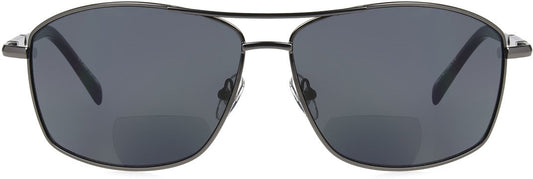
Pilot goggles from decades ago are where the aviator shape comes from, with its teardrop-adjacent lens and thin double bridge. Brayden Gold updates the classic with a subtle tortoise edge. Cason Navy strips the rim away entirely, which we'll get to shortly.
Margaret and Delaney both wear the club (or browline) shape, a bold brow bar across the top half with the bottom half left thin or rimless. FGM-1802 gives it a matte-black, modern spin.
Wrap frames curve around your temple for full coverage. Fog, from the Solar Comfort® line, adds a top bar that blocks light from the sides. You'll mostly find this shape in sport-driven sunglasses, not everyday readers.
Pick a shape you like, and the next question is what it's made of.
What a Frame Is Actually Made Of
Acetate is the plastic most fashion frames are cut from. It takes color and pattern well, from tortoise to marble to solid gloss. That's why it dominates Foster Grant's cat-eye and aviator lines, including Election's tortoise square. Acetate is also behind the brand's recycled-content frames. Some styles in the Foster Grant Styles for Y.O.U.™ collection are made with 50% recycled plastic, including New Rochelle sunglasses and Stapleton readers. That 50% figure is calculated by mass balance. It's an accounting method that tracks recycled material through the supply chain (not a promise about the exact plastic in your exact pair).
Browline and semi-rimless styles that need a low profile usually run in metal or titanium instead. Both are thinner and lighter than acetate. Lizzie's matte black metal cat-eye is one example. Foster Grant's Ti-TECH collection goes further, mixing titanium parts with a frame built from stainless steel and polycarbonate. Its HyperFlexx™ Hinge flexes at the temple instead of snapping.
Foster Grant's toughest builds run on polycarbonate, even though it rarely shows up in the frame front. Guardian Pro Armor and Barrier safety glasses are ANSI- and OSHA-approved, meeting the U.S. impact- and workplace-safety standards those two bodies set. They pair a polycarbonate build with BendToFit® temples you can reshape by hand. The same logic covers kids' styles like Jaxon and Blossom, both rated for ages 3 and up with 100% UVA-UVB lens protection.
Frame material and lens material are two different questions. A metal frame can hold an acetate, acrylic, or polycarbonate lens, so don't assume one dictates the other when you're comparing pairs.